Uber pitches itself as the Amazon of mobility. It is closer to eBay.Amazon built a marketplace on top of infrastructure it controls. Uber coordinates supply it largely does not own. One owns more of the operating stack. The other brokers access to it.
Disruption is the real test of a moat.Scale shows how powerful a moat looks today. Disruption reveals whether it lasts. Amazon’s infrastructure compounds control. Uber’s marketplace is strongest while the suppliers beneath it still need the intermediary.
Autonomy is moving the puck. Uber’s moat has to move with it.Uber’s edge was aggregating fragmented human supply. Robotaxis concentrate scarce technology, fleets, capital, and operating infrastructure in fewer hands. Uber must prove that its demand, dispatch, and commercialization capabilities remain indispensable as suppliers grow larger and more powerful.
Uber is often described as the “Amazon of mobility.” A closer look suggests a different comparison: the “eBay of mobility.” Amazon’s moat is built on infrastructure ownership, operational control, fulfillment depth, and customer trust. Uber’s is a thinner marketplace layer — valuable, but more exposed as autonomous competition reshapes mobility.
Uber’s CEO Dara Khosrowshahi has often framed Uber’s ambition in Amazon-like terms: a platform that begins in one category and expands into a broader transportation and logistics ecosystem. The analogy is appealing. Amazon began with books and expanded into the “everything store.” Uber began with rides and expanded into delivery, freight, and a broader movement platform.1
But the comparison misses the most important distinction: Amazon built a deep operating moat underneath its marketplace. Uber built a powerful marketplace, but much less of the underlying infrastructure that determines service reliability, unit economics, and long-term control.
A closer analogy may be eBay. Like eBay, Uber connects participants: riders with drivers, consumers with couriers, shippers with carriers. The platform creates liquidity, matching, convenience, and demand aggregation. Those are real advantages. But they are not the same as owning the operating system of the category.
Amazon’s moat is anchored in ownership and control. Uber’s moat is anchored in marketplace coordination. That difference matters in normal competition. It may matter even more as autonomous vehicles reshape the economics of mobility.
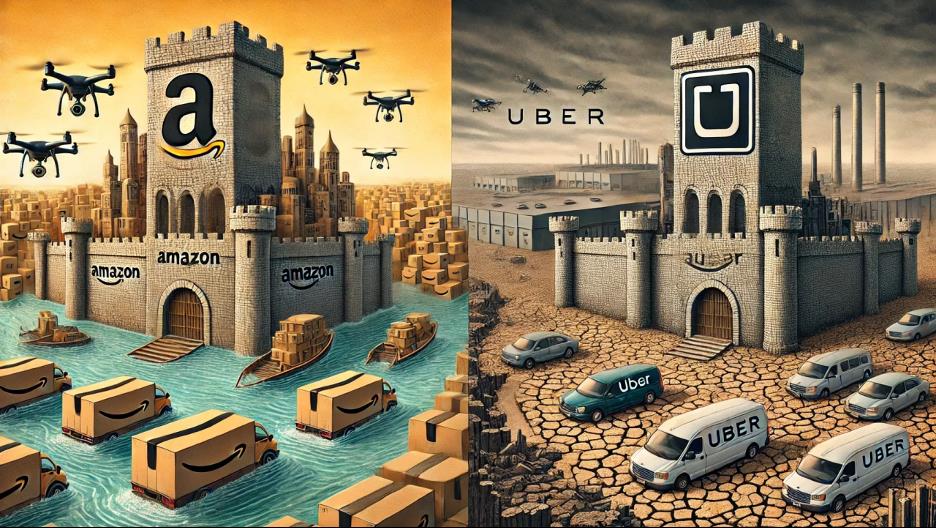
Building Moats: Infrastructure Fortress vs. Marketplace Puddle
Amazon’s logistics network is one of the strongest operating moats in modern commerce. Through Fulfillment by Amazon, third-party sellers can place inventory inside Amazon’s fulfillment network, while Amazon handles storage, picking, packing, shipping, customer service, and returns. That is not just a marketplace feature. It is a control layer. It allows Amazon to shape the customer promise, delivery speed, seller economics, and customer trust at scale.2
That infrastructure changed the nature of Amazon’s marketplace. Amazon did not simply connect buyers and sellers. It increasingly controlled the fulfillment experience underneath the transaction. Sellers gained access to Amazon’s logistics machine. Customers received a consistent promise. Amazon strengthened both sides of the flywheel.
Uber’s core model is different. Its marketplace depends on external vehicle owners, drivers, couriers, restaurants, carriers, and fleet partners. The platform coordinates supply and demand, but it does not generally own the vehicle, employ the driver, manufacture the car, or control the physical asset base. That asset-light model helped Uber scale quickly across geographies and categories. It also limited Uber’s direct control over service quality, availability, and the economics of the physical network.3
That is the core moat difference. Amazon built a castle around the marketplace. Uber built a marketplace layer over assets owned and operated by others.
Pricing Strategy: Stability vs. Volatility
Amazon’s control over logistics and fulfillment also supports a more stable customer experience. Its pricing can be dynamic, but the customer promise is relatively consistent: broad selection, competitive prices, predictable delivery, and reliable service recovery. The customer does not need to understand the complexity of the fulfillment network. Amazon hides that complexity behind the Prime promise.
Uber’s pricing is more visibly volatile. Surge pricing is a rational marketplace mechanism: when demand exceeds supply, price moves to attract more drivers and allocate rides. But what is rational for market clearing can feel unstable to customers. The same trip can cost materially different amounts depending on time, weather, events, traffic, and local supply.
That volatility reveals the difference between a marketplace coordination layer and an owned operating layer. Uber can influence supply through pricing, incentives, and product design. But it cannot fully control supply in the way Amazon can control inventory positioning, warehouse operations, delivery standards, and fulfillment capacity.
Marketplace liquidity is valuable. Operational control is more defensible.
The Autonomous Revolution: Opportunity and Threat
Autonomous vehicles change the strategic question. In a human-driver world, Uber’s asset-light model created enormous flexibility. It allowed the company to aggregate fragmented human supply without owning cars or employing drivers at scale. In an autonomous world, the scarce asset may shift from driver liquidity to autonomous technology, fleet operations, capital access, maintenance infrastructure, mapping, regulatory permission, and fleet utilization.
That shift exposes Uber’s strategic tradeoff. Uber sold its self-driving unit, Advanced Technologies Group, to Aurora in 2020. The decision made sense at the time: AV development was capital intensive, technically uncertain, and far outside Uber’s near-term profitability priorities. But it also meant that Uber would not own the core autonomous stack.4
Uber’s current response is more sophisticated than simply “losing” autonomy. It is trying to become the distribution, demand, fleet-support, and commercialization layer for autonomous operators. The expanded Waymo partnership in Austin and Atlanta is a useful example: Waymo provides the autonomous technology and vehicles, while Uber manages marketplace access and dispatch in those cities.5 Uber has also launched Uber Autonomous Solutions, positioning itself as a partner to AV companies by offering data, mapping, regulatory reach, fleet operations, financing, and marketplace infrastructure.6
That is the best version of Uber’s AV strategy: become the neutral aggregation layer for autonomous supply, just as Amazon became a demand and fulfillment layer for sellers.
But it is also a thinner moat than Amazon’s. If Uber does not own the AV stack, the vehicle, the operating system, or the fleet economics, then its bargaining power depends on whether autonomous operators need Uber more than Uber needs them.
Who Owns the Customer?
This is the decisive question.
If autonomous operators are capital constrained, supply constrained, or geographically fragmented, Uber can be extremely valuable. It can provide instant demand, routing intelligence, dispatch density, payment rails, customer acquisition, trust, and marketplace utilization. In that world, Uber becomes the operating interface through which multiple AV fleets reach consumers.
But if autonomous operators build strong direct-to-consumer brands, own the customer relationship, and operate at scale, Uber’s role becomes less secure. Waymo already operates its own consumer-facing ride-hailing service in markets like San Francisco. Zoox has launched a purpose-built robotaxi service in Las Vegas through its own app experience. Tesla has long framed autonomy as a platform-level opportunity tied to its vehicle base and software stack.7
Those companies do not necessarily need Uber in the same way human drivers did. They may use Uber to accelerate demand in certain cities, but over time the balance of power may shift toward the player that owns the vehicle, the autonomous system, the fleet operations, and the unit economics.
That is the risk. Uber may aggregate demand, but autonomous fleet owners may own the supply-side operating leverage.
Amazon’s model points in the opposite direction. Amazon did not merely aggregate sellers. It built the operating infrastructure that made sellers more dependent on Amazon over time. FBA, Prime, fulfillment speed, customer service, advertising, and marketplace traffic all compounded into a deeper moat. Sellers could reach customers elsewhere, but Amazon increasingly owned the most valuable transaction environment.
Uber’s challenge is to create an equivalent dependency layer in autonomous mobility before AV suppliers build enough scale to go around it.
The AV Aggregator Moat
The bull case for Uber is not that it becomes Amazon. The bull case is that it becomes the dominant AV aggregator.
That is a real possibility. Uber has demand density, marketplace liquidity, global regulatory experience, consumer habit, pricing systems, payments, routing intelligence, and relationships across mobility and delivery. It can help AV companies commercialize faster than they could on their own. It can also offer consumers a hybrid marketplace: human drivers where autonomy is not yet available, AVs where they are, and product choice across price, wait time, geography, and vehicle type.
That hybrid marketplace could be valuable for a long time. Autonomy will not arrive everywhere at once. It will roll out city by city, use case by use case, route by route. In that uneven transition, Uber can play an important role as the demand router across human and autonomous supply.
But an aggregator moat is not the same as an infrastructure moat. Aggregators are powerful when supply is fragmented and customers value comparison, convenience, and liquidity. Infrastructure owners are powerful when the operating system itself is scarce, expensive, and hard to replicate.
Amazon became more than a marketplace because it built the infrastructure underneath commerce. Uber’s question is whether it can build enough infrastructure around autonomous mobility — data, mapping, fleet operations, regulation, financing, support, dispatch, and demand — to avoid becoming merely a demand channel for companies that own the harder technical and physical stack.
Conclusion: Castles vs. Open-Air Markets
The Amazon comparison is useful only if it is precise. Amazon’s moat is not just that it started in one category and expanded into others. It is that Amazon layered marketplace demand on top of deep operational control. It built the castle beneath the marketplace.
Uber has built one of the most important marketplaces in the world. That should not be understated. It created a global habit, a demand network, and a liquidity layer across mobility, delivery, and freight. But its moat is structurally different from Amazon’s. It is less castle and more open-air market: valuable because buyers and sellers gather there, but more exposed when the most important supply starts being owned by vertically integrated operators.
Autonomy does not make Uber irrelevant. It makes Uber’s strategic challenge sharper.
To win the next era of mobility, Uber does not need to become Amazon. But it does need to prove that the AV world still needs an independent marketplace layer — and that Uber can own enough of the customer relationship, fleet orchestration, and commercialization infrastructure to remain indispensable.
In short: Amazon owns its destiny. Uber has the chance to broker the future. The risk is that, in autonomy, the future may be owned by those who build the castle.
Publication Note: This essay was originally published by Sid Breja as a LinkedIn article in January 2025. It was updated in May 2026 for the Moat Vision essay format, with added sources and additional discussion of subsequent developments in Uber’s autonomous-vehicle partnership and aggregation strategy. The core thesis is unchanged.
Disclaimer: Sid Breja is a former employee of Amazon, Uber, and eBay. The views expressed in this essay are solely his own and do not reflect the views of any current or former employer. This essay is for informational and discussion purposes only and should not be interpreted as investment advice.
Sid Breja is the founder of Moat Vision and a former finance and strategy executive at Amazon, Uber, eBay, Capital One, and JUUL Labs. His work spans profitable growth, marketplace economics, capital allocation, M&A, and competitive advantage.